Bedding · Materials & Care
Naturepedic Organic Linen Sheets: A Guide to Fiber, Feel, and Care
Linen begins as a field plant and ends as a fabric shaped by fiber, weave, finishing, and use. Understanding those steps makes it easier to know what to expect from organic linen sheets—and how to care for them as they settle into everyday life.
At first touch, linen can seem unlike the smooth, even surface many people associate with bedding. Its texture has a subtle irregularity: a small variation in the yarn, a quiet grain in the weave, a drape that feels substantial without being dense. These qualities are not flaws to be corrected. They are part of the material’s character, shaped by the flax plant and preserved, to varying degrees, through spinning, weaving, and finishing.
Naturepedic organic linen sheets are described as being made from GOTS-certified flax linen, with flax grown in France and the finished fabric produced in a GOTS-certified facility in India. The listed fabric weight is 185 grams per square metre, and the sheets are stone-washed. Those details offer a useful starting point for understanding the set: where its fiber comes from, how its weight may affect the hand, and why the surface feels relaxed rather than sharply crisp.
No single specification tells the whole story of a sheet. Fiber, yarn, weave, finish, fit, climate, and personal preference work together. A thoughtful choice begins not with a search for a universally “best” fabric, but with a clearer sense of the qualities that matter in your own bed.
From flax plant to linen fabric
Linen is made from the bast fibers found in the stem of the flax plant, Linum usitatissimum. The plant grows as a slender annual crop, and its useful fibers lie in bundles beneath the stem’s outer layer. Turning those fibers into cloth takes a sequence of agricultural and textile processes. Once harvested, flax is treated to separate the fiber from the woody stem, then cleaned, aligned, spun into yarn, and woven.
The journey matters because “linen” names a fiber and fabric family, not one fixed texture. Yarn thickness, spinning method, weave structure, finishing, and fabric weight all affect the result. Two linen sheets can both be made from flax and still differ noticeably in smoothness, drape, weight, and wrinkle pattern. The broad identity of the fiber is only the opening chapter.
Flax fibers are valued for strength and for their ability to absorb and release moisture. In bedding, these properties contribute to a fabric that can feel airy while retaining a reassuring substance in the hand. Linen’s characteristic texture also reflects the natural variation in its yarns. Unlike a perfectly uniform surface, it often carries small shifts in thickness and a softly visible grain.
The word “organic” describes a standard for how agricultural fiber is grown and processed; it does not, by itself, guarantee a particular level of softness, coolness, or durability. Those qualities depend on the whole textile and how it is made. When a product carries a recognized certification, readers should check what the certification applies to and whether the item’s documentation supports the claim. Naturepedic’s product information identifies the sheets as GOTS certified, a detail worth verifying against current product labeling and certification records when making a purchase.
What the fabric weight can tell you
Naturepedic lists its organic linen sheets at 185 gsm, or grams per square metre. This measurement describes the mass of the fabric across a standard area. It is useful when comparing textiles, but it should not be treated as a direct score for quality. A higher number does not automatically mean a better sheet, and weight alone cannot predict softness, breathability, or lifespan.
At 185 gsm, the fabric has a defined presence rather than the especially light feel of some fine cotton sheeting. The actual sensation also depends on the weave and finish, the yarn structure, and how the fabric is handled after weaving. A stone-washed surface, for example, is processed to create a softer, more lived-in hand than a stiff or tightly finished textile might have when new.
Weight can be useful for setting expectations. People who prefer a crisp, feather-light surface may respond differently from those who enjoy a more textured sheet with a visible drape. Linen’s feel is often best judged over several nights, after the fabric has been laundered and made up on the bed. A first impression is informative, but it is not the whole experience.
How linen feels beside cotton
Comparisons between linen and cotton are most helpful when they focus on weave and finish as well as fiber. Cotton percale is commonly associated with a matte, cool, crisp hand. Cotton sateen tends to feel smoother and more fluid because of its weave structure. Linen generally presents a more pronounced texture and a relaxed drape, though individual fabrics vary widely.
These differences are tactile, not a simple contest between materials. Someone who likes a smooth surface may prefer a finely finished cotton sheet; another person may welcome linen’s irregular, natural grain. Linen can feel cool at first contact, but the sensation of temperature depends on room conditions, bedding layers, sleepwear, and the person using it. Fabric does not regulate the body in isolation.
Linen is also known for moisture management. Its fibers can absorb moisture and release it as conditions allow, helping the surface feel less clammy for some sleepers. This does not mean linen prevents sweating or guarantees a particular sleep temperature. The room’s ventilation, mattress construction, duvet warmth, humidity, and individual physiology all play a part.
Over time, repeated washing and use often change linen’s hand. The fabric may become more supple and comfortable while retaining its textured appearance. Softening is gradual and varies with the initial finish and the care routine. There is no need to accelerate the process with harsh detergents, high heat, or aggressive washing; those methods can place unnecessary strain on fibers and seams.
A closer look at the Naturepedic set
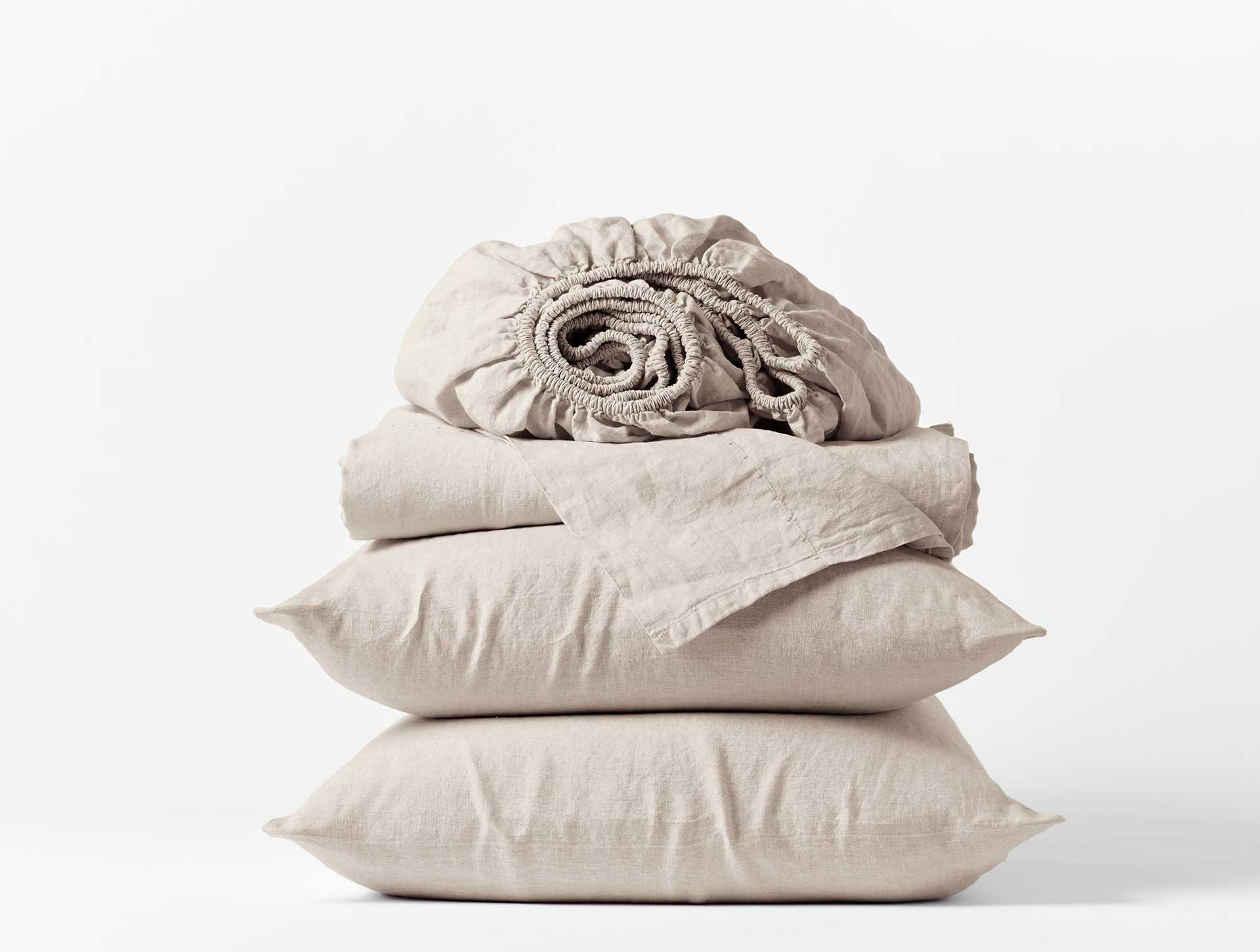
The listed Naturepedic organic linen sheet set is made from GOTS-certified organic flax linen, with flax grown in France and manufacturing in India at a GOTS-certified organic facility. Its stated fabric weight is 185 gsm. The set is offered in Queen, King, and California King sizes, and includes a flat sheet, a fitted sheet, and two pillowcases. The fitted sheet has a 15-inch pocket.
These specifications answer practical questions as well as material questions. A 15-inch pocket is relevant to mattress depth, including any topper, protector, or pad that adds height. Before choosing a size, measure the mattress from its surface to the bottom edge, rather than relying only on its advertised dimensions. Mattress corners vary in shape, and a deep pocket cannot compensate for a size mismatch or an unusually thick sleep system.
It is also worth checking the precise contents for the selected size and confirming current color and size availability. Set configurations can differ by brand and size, and product information may change. For a comparison with another organic linen option, the [Organic Relaxed Linen Sheet Set](/products/organic-relaxed-linen-sheet-set-5826) is described as flax grown in France, linen woven in Portugal, GOTS certified, and constructed with a 15-inch deep-pocket fitted sheet. Differences in origin, finish, and construction are useful points of comparison, though they do not alone establish which set will feel better to a particular sleeper.
A sensible laundering routine
Good linen care is less about complicated rituals than about avoiding extremes. Follow the care label first, because the manufacturer’s instructions are specific to the finished product. For the Naturepedic sheets, the listed guidance is machine wash warm, tumble dry low, warm iron if desired, and no bleach. If the label on the set in hand gives updated or more specific directions, follow that label.
Before washing, separate light and dark colors, and avoid overcrowding the machine. Fabric needs room to move through the wash and rinse; a packed drum can increase friction and leave detergent behind. Use a measured amount of a mild detergent, taking account of the detergent instructions and load size. Excess detergent is not a shortcut to cleaner bedding and may leave residue in the fibers.
- Wash gently: Use the temperature and cycle specified on the care label. A warm wash is listed for this set; gentler settings may help limit wear when compatible with the instructions.
- Skip bleach: The product guidance says not to bleach. Avoid chlorine bleach and do not substitute whitening treatments without checking that they are safe for the fabric and its dyes.
- Dry with care: Tumble dry low, as directed. Remove the sheets when dry rather than leaving them exposed to unnecessary heat for an extended cycle.
- Iron only if wanted: A warm iron is an option, not a requirement. Many people prefer linen’s relaxed creases and natural surface.
- Store fully dry: Make sure sheets are dry before folding them away, and store them in a clean, dry place with room for air circulation.
Frequent high heat can stress fibers and affect the way a textile holds its shape. Likewise, fabric softener is not automatically necessary; the sheets are already described as stone-washed, and additional products may leave a coating or alter the fabric’s feel. If you are considering a stain treatment, test it discreetly and check the care instructions first. A simple routine is generally easier to maintain and easier on a well-used set.
Wrinkles, drape, and the lived-in surface
Linen wrinkles because its fibers do not behave like an elastic, wrinkle-resistant synthetic. The resulting folds are part of the material’s familiar appearance. Some people find that texture calming and informal; others prefer a more pressed finish. Neither response is wrong. The useful question is whether the fabric’s everyday appearance suits the room and the amount of time you want to spend on bed-making.
To reduce pronounced creases without aiming for a perfectly flat surface, remove sheets from the dryer promptly and fold or place them on the bed while they are still slightly warm. If ironing is part of your routine, follow the label and use the recommended warm setting. A smooth appearance is possible, but it is not necessary for the fabric to perform as bedding.
As linen softens, its drape may become more relaxed. This evolution is one reason many people enjoy the material: the sheet becomes familiar through use rather than remaining exactly as it felt on the first night. Even so, softness is not a reliable test of fiber quality on its own. The finish, laundering history, and individual sense of touch all influence perception.
Fit matters as much as fiber
A fitted sheet that fits poorly can distract from every positive quality of the fabric. Measure mattress length, width, and depth, including any topper or protector used regularly. Compare those dimensions with the brand’s size chart and the sheet’s pocket depth. A secure fit should hold through normal movement without excessive tension at the corners.
The 15-inch pocket listed for Naturepedic’s fitted sheet offers a clear reference, but mattress depth varies. If your mattress is close to that measurement, allow for added layers and check the manufacturer’s guidance on how pocket depth is measured. A sheet stretched to its limit may pull free at the corners or place strain on seams, while one that is too loose can bunch beneath the sleeper.
Set contents matter, too. Confirm the number and size of pillowcases, whether the fitted sheet is included, and whether the flat sheet dimensions suit the bed. Keep the packaging or product record until you have checked the items. These small checks are practical, especially when a set is being purchased for a mattress with an unusual depth or for a bed that uses oversized pillows.
Organic claims and careful reading
Interest in organic bedding often comes from a desire to understand how fibers are grown and processed. Certification can provide a framework for evaluating those claims, but readers should distinguish a certified statement from broad language such as “natural” or “eco-friendly.” Look for the named standard, the scope of certification, and confirmation that the specific product—not merely a brand or a different item in its range—is covered.
GOTS, the Global Organic Textile Standard, is a recognized textile certification system. Its criteria address organic fiber and aspects of processing and supply-chain responsibility. A label should be read in context: certification does not mean that a product has no environmental impact, nor does it guarantee a particular feel or performance. Agricultural production, processing, transport, use, and laundering all contribute to a textile’s wider footprint.
Durability and care are part of the environmental picture as well. A textile used for many years may serve a different role in a household than one that needs frequent replacement. Washing in accordance with the care label, avoiding unnecessary heat, and repairing small issues when practical can help extend the useful life of bedding. Such habits do not erase production impacts, but they make responsible use concrete and measurable at home.
Choosing linen for your own bed
Before selecting organic linen sheets, think through the conditions in which they will be used. Consider whether you prefer a textured or smooth hand, whether you tend to sleep warm, how often you wash bedding, and whether you are comfortable with visible creasing. Measure the mattress, read the care instructions, and check the complete set contents. These questions are more useful than relying on a single headline feature.
If possible, compare linen with the sheets you already own. A familiar cotton percale set can serve as a reference for crispness; a sateen set may clarify whether you prefer a smoother, more fluid surface. Linen’s appeal often lies in its combination of texture, breathability, and relaxed drape, but the right choice is ultimately personal. A fabric’s reputation cannot substitute for your own tactile preference.
For the Naturepedic set, the essential details are straightforward: organic flax linen, a listed weight of 185 gsm, stone-washed finishing, a 15-inch fitted-sheet pocket, and care instructions that call for warm machine washing and low tumble drying. Together, these details sketch a picture of a substantial yet breathable sheet designed for regular use. They also provide a sensible checklist for comparing linen bedding across brands.
The quiet life of a sheet
Sheets are among the most frequently handled textiles in a home. They are pulled across mattresses, folded, washed, dried, and returned to service in a repeating cycle. Linen’s qualities emerge in that ordinary rhythm. The texture becomes familiar, the cloth takes on a softer hand, and its creases record the practical movement of daily use.
Understanding the route from flax to fabric helps put those sensations into perspective. Fiber gives linen its basic character; weave and weight shape its body; finishing influences the first touch; laundering and use continue the change. No specification can fully describe the experience of sleeping on a sheet, but together, these clues help set realistic expectations.
A considered choice is not necessarily the most elaborate one. It is the one that fits the mattress, feels right against the skin, suits the household’s care routine, and remains useful over time. With those basics in view, organic linen becomes less an abstract promise and more a material to understand—one wash, one night, and one season at a time.